
This Tennessee Septic Permit Process and TDEC Permit Lookup page is maintained as conservative homeowner guidance and changes when its state evidence or workflow changes.
TN homeowner guide
Tennessee Septic Permit Process and TDEC Permit Lookup
01
Permit authority
Open county permit pages
02
What to bring
Tennessee Septic Permit Process and TDEC Permit Lookup file check: Parcel identifier, address, owner name, or permit number needed to pull the county file.
03
Before you price
Tennessee Septic Permit Process and TDEC Permit Lookup quote hold: Do not move into quote mode while the parcel, GIS, or records-request trail is still missing.
Open county route
Montgomery County records
Blount County records
Wilson County records
All county pages
Tennessee permit content is stronger than a generic install checklist because the real homeowner path runs through the TDEC SSDS permit hub, the TDEC regional contact, or a contract county office. Start by confirming whether the parcel needs a permit lookup, construction permit, repair permit, or inspection-letter path before regional-contact and repair-permit friction widens the job.
Fast next steps
Anderson County TN Septic Permit Search and TDEC Records
Cumberland County Tennessee Septic Records and Permit Lookup
Davidson County TN Septic Records and Property File Search
Knox County Tennessee Septic Records Checklist and Permit Lookup
Loudon County TN Septic Records Search and Permit Files
A permit process matters when it leads to the property file.
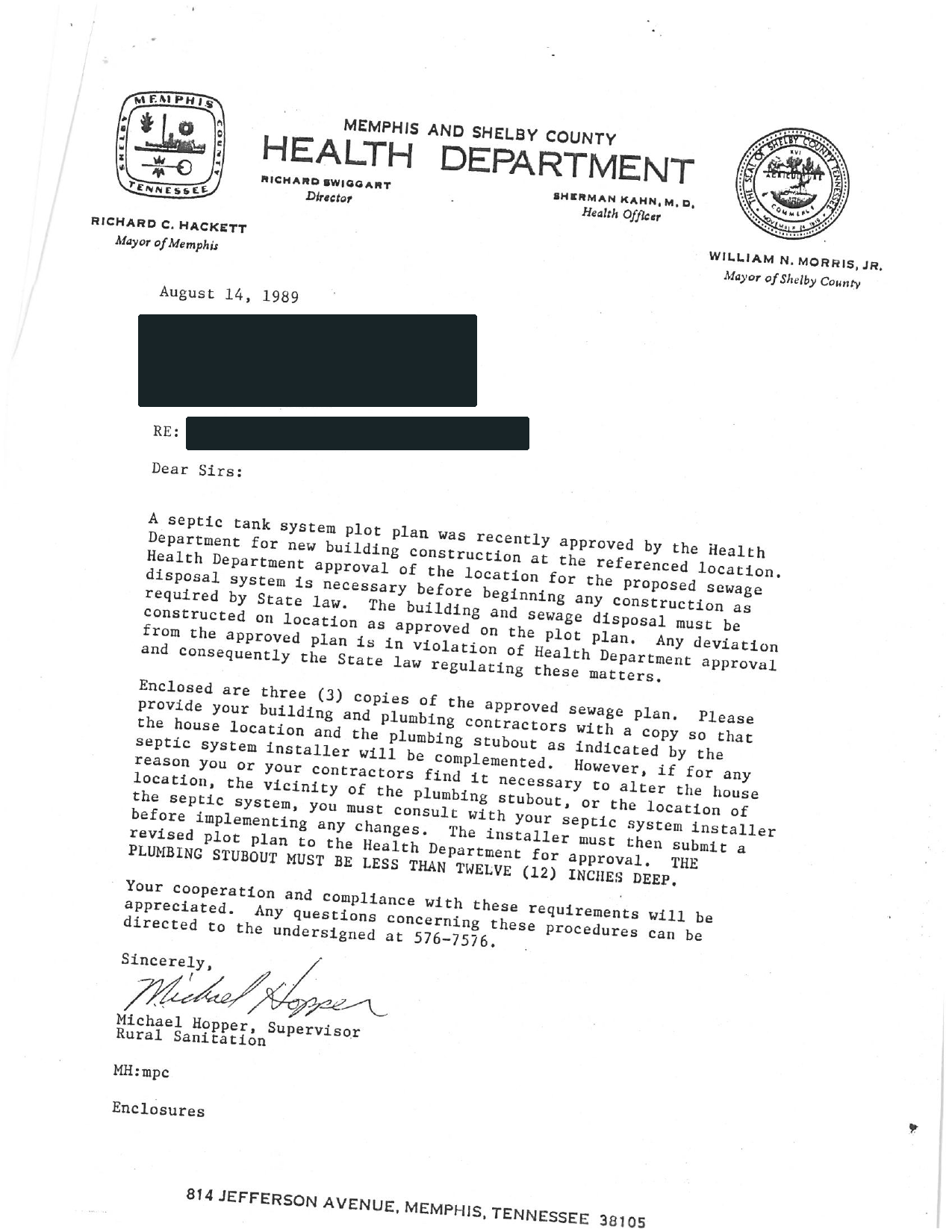
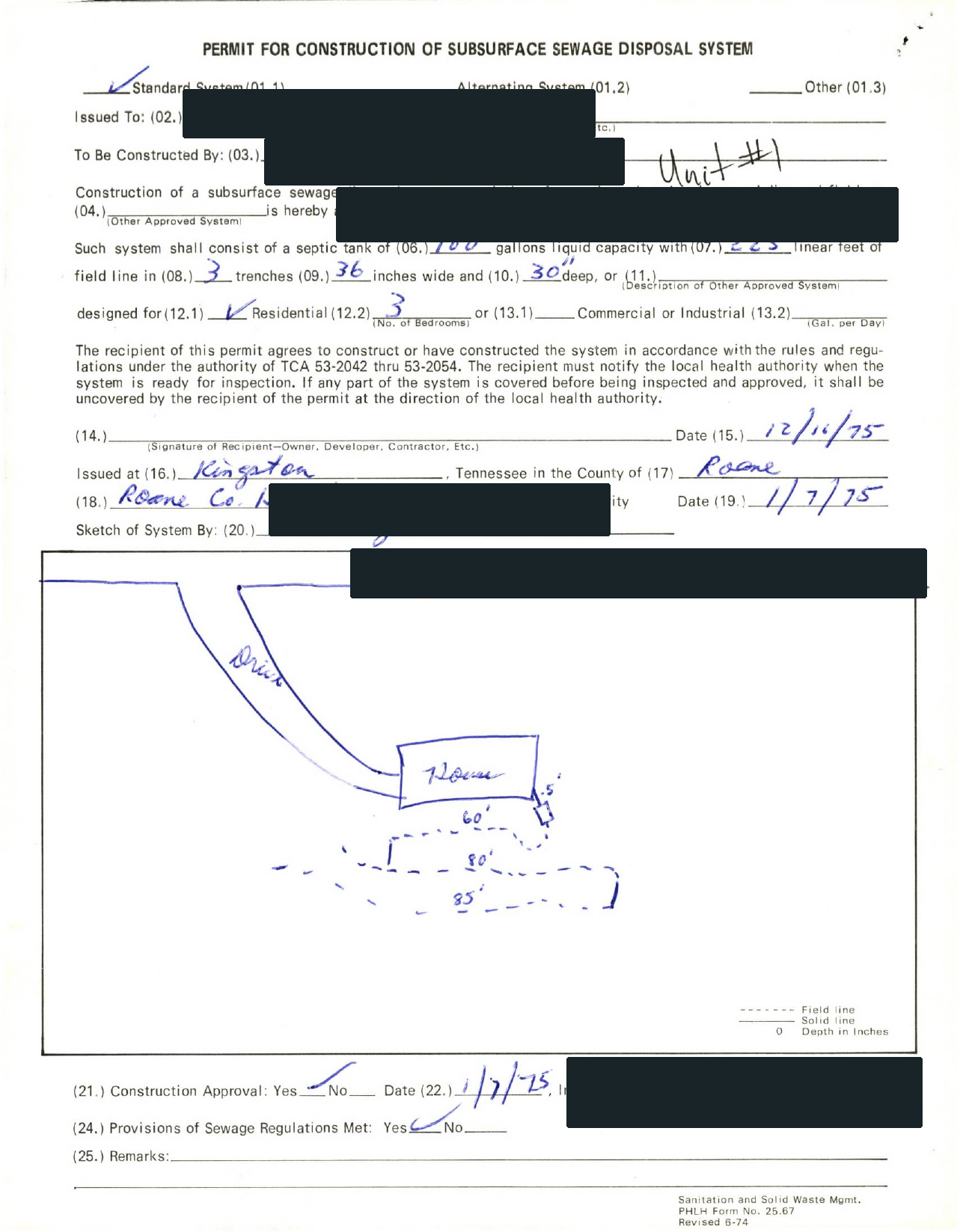
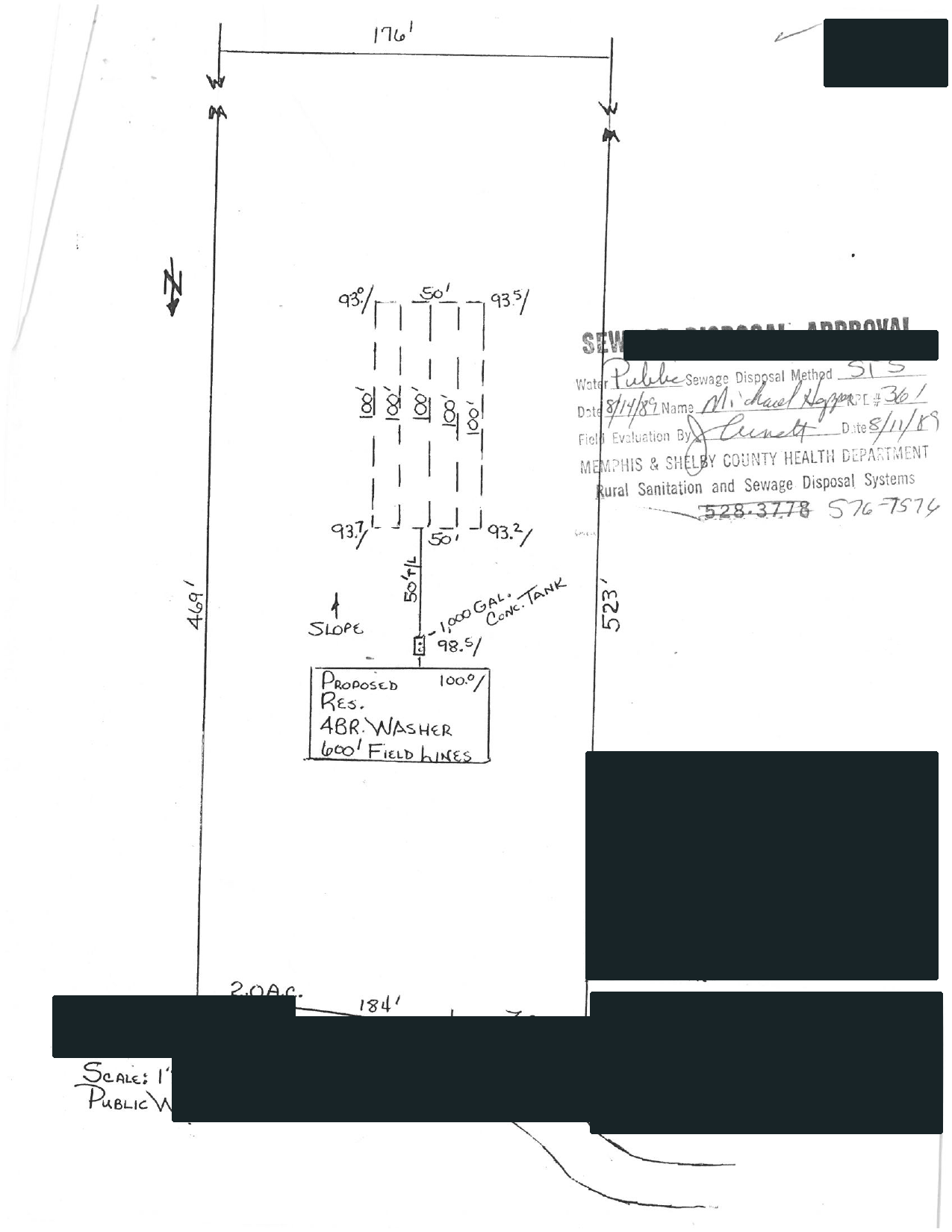
Actual agency approvals, historical permits, and approved plans show what the Tennessee workflow is ultimately meant to produce—and what SepticPath can help explain.
01 / RECEIVED FROM THE COUNTY
Swipe to compare the original pages Document 1 of 3
02 / EXPLAINED BY SEPTICPATH
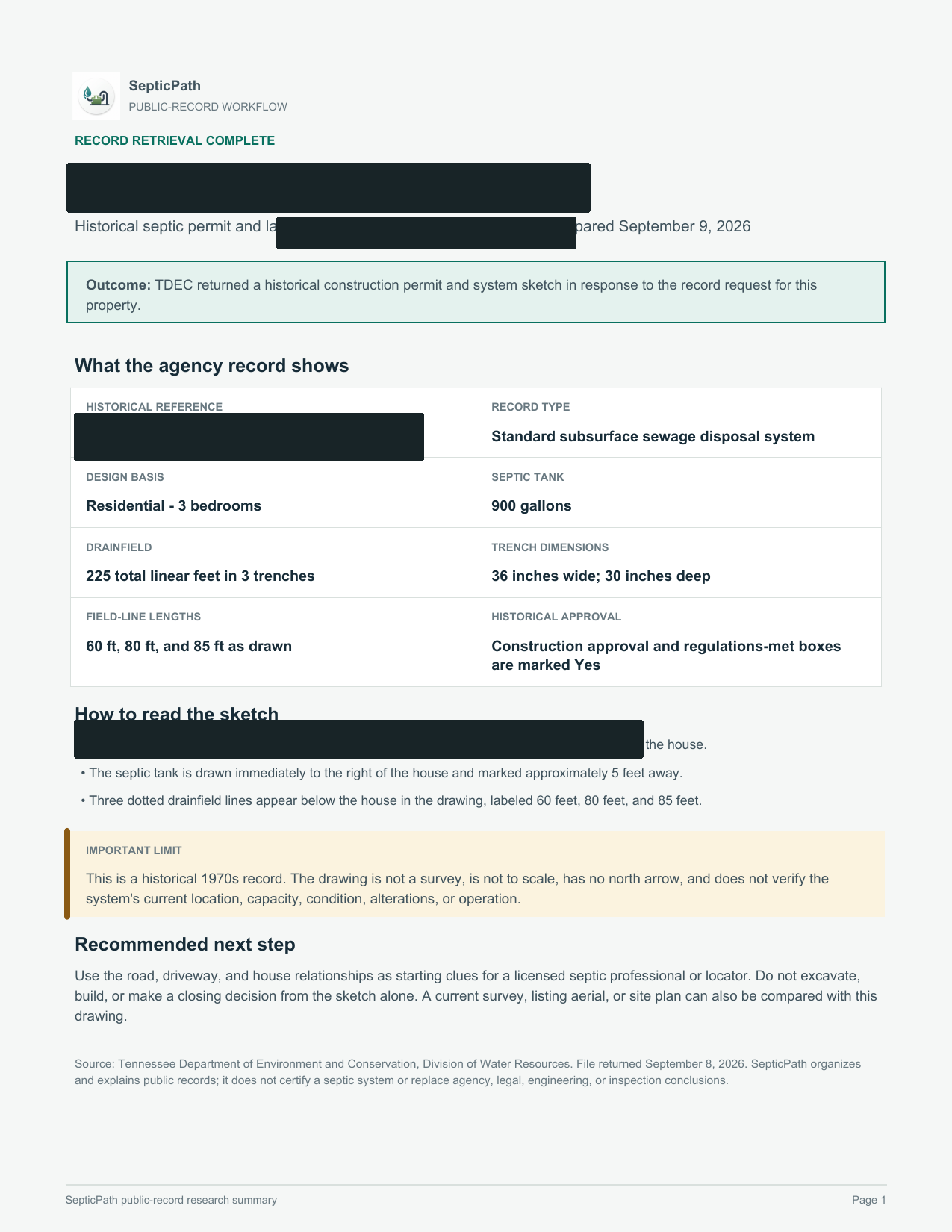
SepticPathRECORD BRIEF
What this helps withA starting point for discussing the layout with a septic professional.
What it does not proveThis is an approved design, not proof of the system’s current location or condition.
Open the delivered brief ↗Privacy reviewed: black bars remove identifying details; agency language, form structure, system data, and drawing geometry remain visible. Samples are from separate requests, not one property file. Record availability varies by property and jurisdiction.
- Identify the permit authority
- Retrieve the property file
- Explain approvals and gaps
Investigate my property
Send the address and what you need to find out.
Find the office handling this permit path
For Tennessee Septic Permit Process and TDEC Permit Lookup, use the local office first when you want to move from a planning page into an actual permit or records workflow.
Open local authority sourcePull the permit file first
For Tennessee Septic Permit Process and TDEC Permit Lookup, use the existing record trail to confirm whether this property still fits the low end before you move into quote mode.
Open records lookupState context Quick facts, fit, and workflow details Open when you need the full state context behind the answer panel.
Quick facts
| Rule style | Permit and records path | Override risk | high |
|---|---|---|---|
| Last verified | 2026-03-10 | Official sources | 4 |
| Local verification links | 2 | Records links | 3 |
| Public sizing signal | Conservative fallback range | Primary first call | Start with the correct TDEC regional contact or the contract county office that handles septic assistance for the property. |
| County-backed first pull | Tennessee Septic Permit Process and TDEC Permit Lookup file check: Parcel identifier, address, owner name, or permit number needed to pull the county file. | Hold pricing when | Tennessee Septic Permit Process and TDEC Permit Lookup quote hold: Do not move into quote mode while the parcel, GIS, or records-request trail is still missing. |
Permit prep checklist
- Open the regional contacts page first and confirm whether the parcel is handled by a contract county or a TDEC contact.
- Ask for the construction permit, any repair permit, and any inspection letter or prior file tied to the property.
- Confirm whether soil or site limits are pushing the job toward an alternative system before you anchor to the low end.
Who this page is for
Best for Tennessee owners, buyers, builders, and agents who need to know which office controls the permit path and why the file can move the project before the installer quote feels real.
- You have an install or replacement quote, but no one has confirmed which TDEC regional contact or contract county office actually controls the permit path.
- The contractor says the permit is routine, but no one has surfaced the construction permit and repair permit or the local file already tied to the lot.
- You need to know whether regional-contact and repair-permit friction could break the low-end permit story before you schedule work.
What changes this page in Tennessee
Best for Tennessee owners, buyers, builders, and agents who need to know which office controls the permit path and why the file can move the project before the installer quote feels real. Tennessee permit intent is strongest when the page connects TDEC permit lookup language, SSDS record search behavior, regional contact or contract county routing, construction permit and repair permit, and file quality instead of pretending one statewide office owns the whole path.
Tennessee Septic Permit Process and TDEC Permit Lookup permit context: Tennessee homeowners usually need the permit file before they trust a replacement number. The practical path changes depending on whether the job is installation, failing-system repair, or an inspection-letter pull tied to a sale or mortgage, and it can change again if the county is a contract county. The first practical check is usually the office, file path, or reviewer identified in this state workflow: Start with the correct TDEC regional contact or the contract county office that handles septic assistance for the property.
Tennessee Septic Permit Process and TDEC Permit Lookup local exception: Tennessee's main wrinkle is the split between contract-county routing and TDEC contacts plus the inspection-letter path that often matters before replacement or buyer decisions. That is why this page pairs a planning estimate with official sources, records links, and a local checklist before you move into quote mode.
Main estimate drivers in Tennessee
- Tennessee permit conversations get real only after the TDEC regional contact or contract county office is clear.
- construction permit and repair permit quality can matter more than a generic statewide permit article implies.
- regional-contact and repair-permit friction can widen the project before the permit fee or schedule feels final.
How this workflow usually unfolds in Tennessee
- Identify the TDEC regional contact or contract county office first because that office controls the practical next permit step for the parcel.
- Ask for the construction permit and repair permit, the permit file, and any prior approval or design record tied to the property before treating the job as routine.
- Use the local file to decide whether the property is still on a clean install or replacement path or whether a bigger review story is already visible.
- Then compare permit timing, file quality, and project risk before you schedule work around the lowest quote.
County Wedge
County permit pages behind this state workflow
Use these Tennessee routes when the state permit page is still too broad and the real blocker is a county permit desk, closeout artifact, or local repair branch.
Montgomery County Tennessee Septic Records Checklist and Permit Lookup
Open county pageBlount County TN Septic Records and SSDS Request
Open county pageWilson County Tennessee Septic Records Checklist and Permit Lookup
Open county pageSevier County Tennessee Septic Records Checklist and Permit Lookup
Open county pageDavidson County TN Septic Records and Property File Search
Open county pageHamilton County TN Septic Inspection Records and Permit Lookup
Open county pageMore county pages are available
This Tennessee Septic Permit Process and TDEC Permit Lookup page shows the strongest six Tennessee county routes first so the workflow stays scannable. Use the state records page when you need the wider county list.
Open all Tennessee county routesShow all county page links on this page
- Knox County Tennessee Septic Records Checklist and Permit Lookup
- Madison County TN Septic Drawing and Records Request
- Anderson County TN Septic Permit Search and TDEC Records
- Shelby County TN Septic Records and Permit File Request
- Loudon County TN Septic Records Search and Permit Files
- Cumberland County Tennessee Septic Records and Permit Lookup
- Williamson County Tennessee Septic Records Checklist and Permit Lookup
- Bradley County TN Septic Permit Lookup and TDEC Records
- Jefferson County TN Septic Permits, Final Approval and Records
- Maury County TN Septic Permit Lookup and TDEC Records
- Putnam County TN Septic Permit Search and TDEC Records
- Rutherford County Tennessee Septic Records Checklist and Permit Lookup
- Sullivan County TN Septic Layout and Records Request
- Sumner County Tennessee Septic Records Checklist and Permit Lookup
- Overton County TN Septic Permit and Historical Record Search
- Roane County TN Septic Permit Lookup and Layout Records
- Washington County Tennessee Septic Records Checklist and Permit Lookup
Verification layer Prep checks and official sources Open when you need the authority links, records sources, and low-end risk checks.
Start with this permit prep
Who to call first. Start with the correct TDEC regional contact or the contract county office that handles septic assistance for the property.
Records to request.
- The septic system construction permit and any repair permit tied to the current system.
- Any inspection letter documenting the status of the existing septic system for sale, mortgage, or subdivision use.
- Any sketch, soils map, or site file already attached to the permit record.
What turns this Tennessee permit path into a bigger job
State-level checks.
- If the homeowner has not confirmed whether the parcel is handled by a contract county or a TDEC regional office, the low end is still a planning scenario.
- If the job actually needs a repair permit for a failing system, the project can be wider than a simple replacement quote suggests.
- If soil or site conditions push the job toward an alternative system, the replacement path can widen quickly.
- Tennessee looks statewide through TDEC, but the practical homeowner path changes quickly once you know whether the parcel is handled by a contract county or a TDEC regional contact and whether the permit file is complete.
Page-specific checks.
- The permit story widens fast if no one has identified the TDEC regional contact or contract county office actually holding the file.
- A missing construction permit and repair permit can make the project more complex than the owner or contractor summary suggests.
- regional-contact and repair-permit friction can push the job beyond a simple permit conversation quickly.
Permit timeline watch
Tennessee timing often turns on how quickly the permit file is pulled, whether an inspection letter is needed for a transaction, and whether the job stays conventional or widens into an alternative-system conversation.
Long-run maintenance note
Tennessee's current source set is strongest on permit timing, repair permits, and inspection-letter workflow, not on one simple statewide pumping cadence.
Special state wrinkle
Tennessee's main wrinkle is the split between contract-county routing and TDEC contacts plus the inspection-letter path that often matters before replacement or buyer decisions.
Bring this into the next permit call
- The TDEC regional contact or contract county office handling the parcel's permit path.
- The construction permit and repair permit, permit file, and any design or approval paperwork already tied to the site.
- Any note showing whether the current path is install, replacement, redesign, or permit cleanup.
- A short note on whether the lot still appears straightforward once the file is open.
Official permit and file links
Tennessee: Find the office handling this permit path.
- Tennessee Department of Environment and Conservation Environmental Field Offices Directory
- Tennessee Department of Environment and Conservation TDEC Public Records Request
Pull the permit file first.
- Tennessee Department of Environment and Conservation TDEC Public Records Request
- Tennessee Department of Environment and Conservation Environmental Field Offices Directory
- Tennessee Department of Environment and Conservation Current SSDS Record Search
- Tennessee Department of Environment and Conservation Subsurface Sewage Disposal Systems Program
- Tennessee Department of Environment and Conservation Online Application for Septic Related Services
- Tennessee Department of Environment and Conservation TDEC Public Records Request
- Tennessee Department of Environment and Conservation TDEC Programs and Contacts
FAQ
Tennessee questions this page should answer before a quote request.
What is the first Tennessee permit step a homeowner should take?
Start with the TDEC SSDS permit hub, the permit lookup or record-search path it links, and the correct regional or contract county contact before treating the project as routine.
Why does Tennessee permit content need to mention construction permit and repair permit?
Because the construction permit and repair permit often marks where the homeowner moves from a planning story into the real local approval sequence.
Estimate before the permit-file pull
Tennessee quote conversations get more real once you know whether the parcel runs through a contract county or TDEC contact and whether a repair permit or inspection letter is already in the file. The calculator result already shows the likely tank band, system class, cost range, and state-specific rule context. Use the file, permit, or authority path above before you move into quote mode.
Related links
- Shelby County TN Septic Records and Permit File Request
- Tennessee Septic Records by County
- Tennessee Septic Replacement Cost
- Septic Permit Search by Address
- Septic Permit Records Request
- Tennessee septic guide
- Septic Permit Lookup by State
- Tennessee Septic Inspection Cost
- Septic Records by County
- How to Find Septic Records Online
- Septic As-Built Records
- Septic Inspection Letter