
This Minnesota Septic Records Checklist and Permit Lookup page is maintained as conservative homeowner guidance and changes when its state evidence or workflow changes.
MN homeowner guide
Minnesota Septic Records Checklist and Permit Lookup
Current verdict
Find the county file before you trust the story.
01
Who holds the file
Open county record lookup paths
02
What to bring
The written septic disclosure tied to the sale.
03
Before you price
Minnesota Septic Records Checklist and Permit Lookup quote hold: Do not move into quote mode while the parcel, GIS, or records-request trail is still missing.
County records
Already know the county? Go straight to its official record route.
St. Louis County records Blue Earth County records Dakota County records Chisago County records All Minnesota county pagesMinnesota records lookup starts with the permit search, county file, or official office path. Minnesota records work is less about one statewide file and more about getting the right local SSTS program file in hand. If the homeowner cannot surface the prior compliance-inspection report, the permit trail, and any written seller disclosure, the low end is still just a planning story.
Answer at a glance
Minnesota records lookup guide
Use this Minnesota guide to pick the right office, pull the first file, and jump to a county route when the property location is already known.
Official source: Minnesota Pollution Control Agency · content reviewed 2026-03-10
| Finding an existing record | Search for the property's permit and supporting documents using its address or parcel number. If no record appears, ask the responsible office to check its archives. |
|---|---|
| Official path | Disclosing SSTS at property transfer provides official source context. The county instructions above identify the search or request route for an existing property file. |
| County handoff | Local search instructions are available for St. Louis County records, Blue Earth County records, Dakota County records. Choose the property's county to find the relevant office and records route. |
| Proof to pull | The written septic disclosure tied to the sale. |
We chase the file. Then make it usable.
Selected full pages from separate completed requests: original agency records, hand-drawn plans, and the brief delivered after review.
01 / RECEIVED FROM THE COUNTY
Swipe to compare the original pages Document 1 of 3
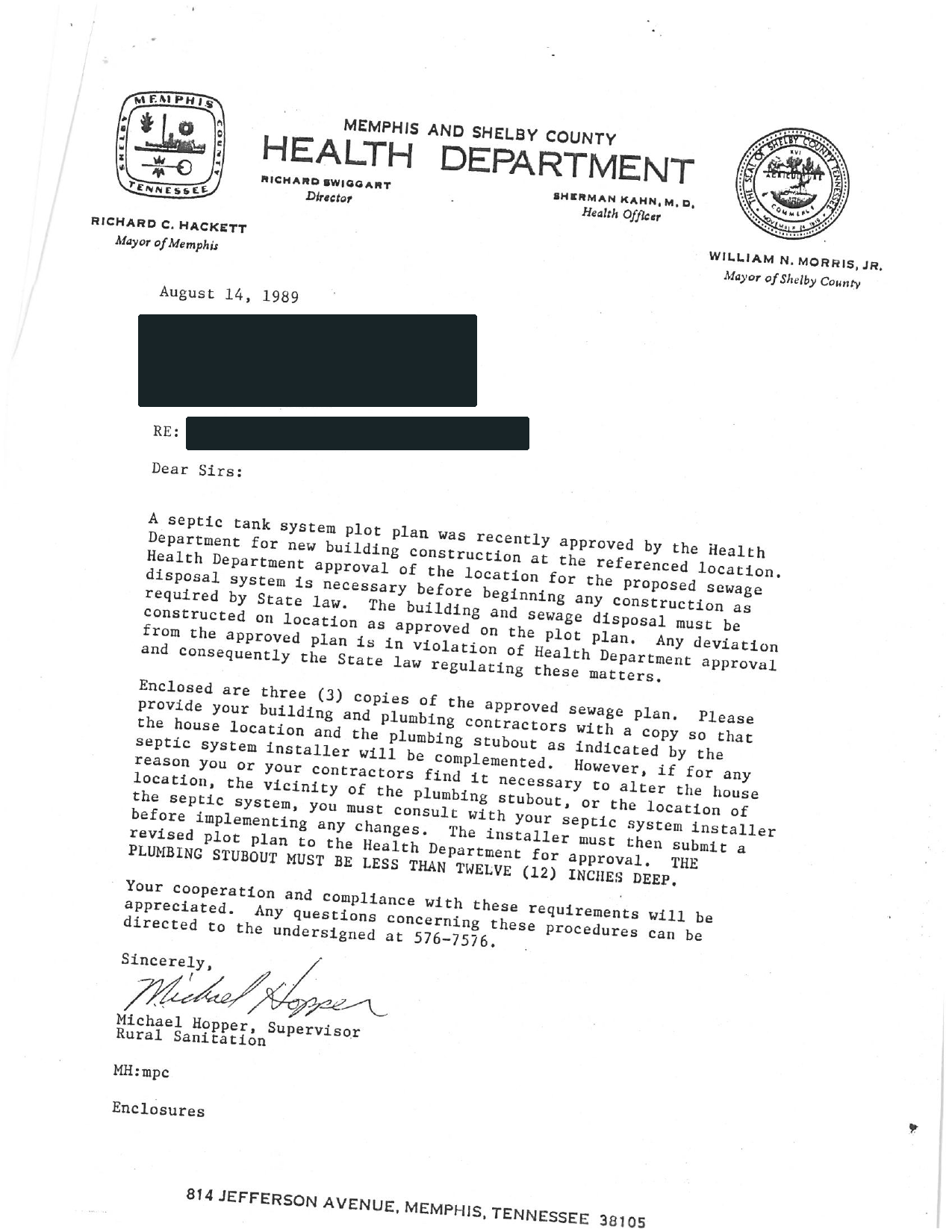
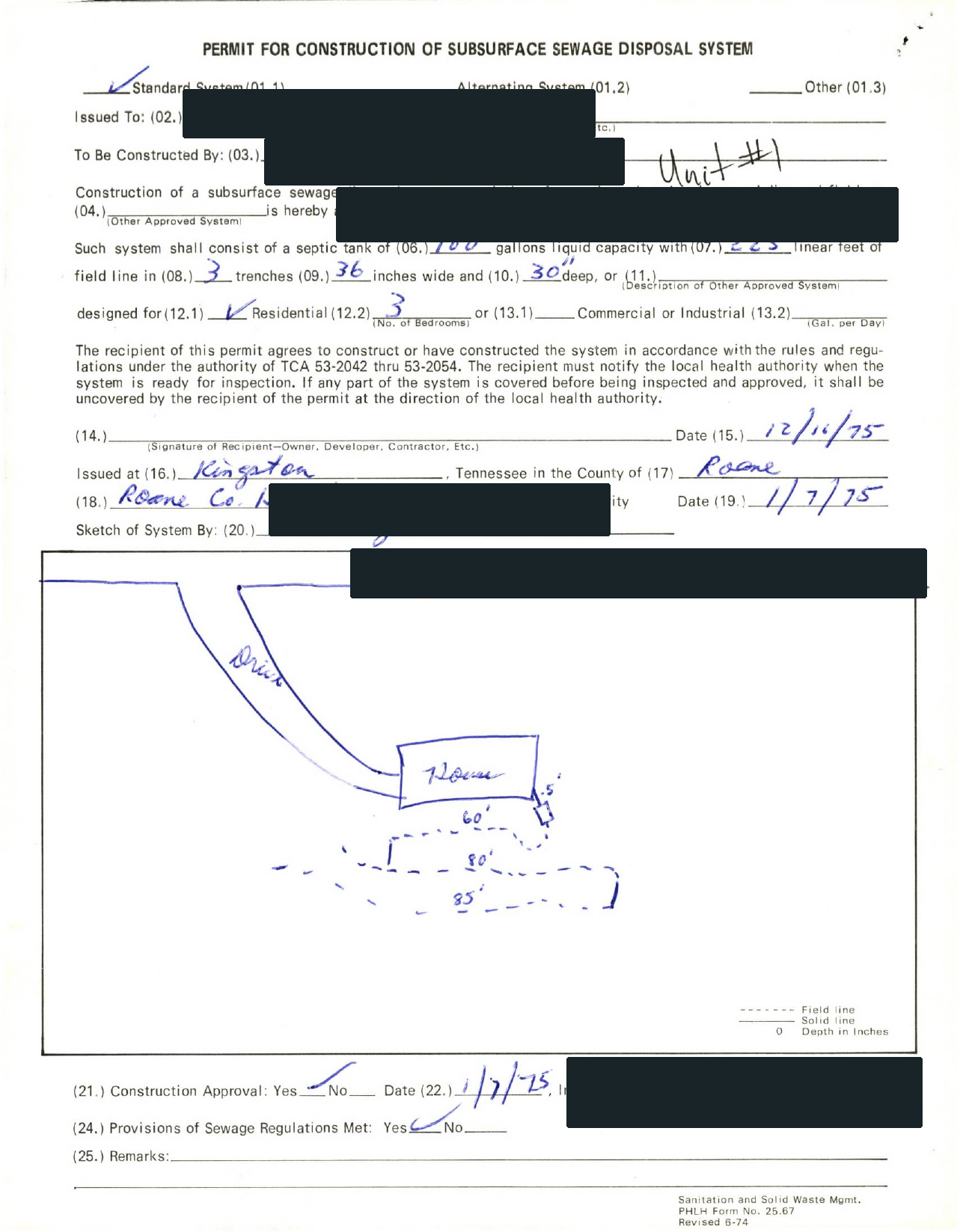
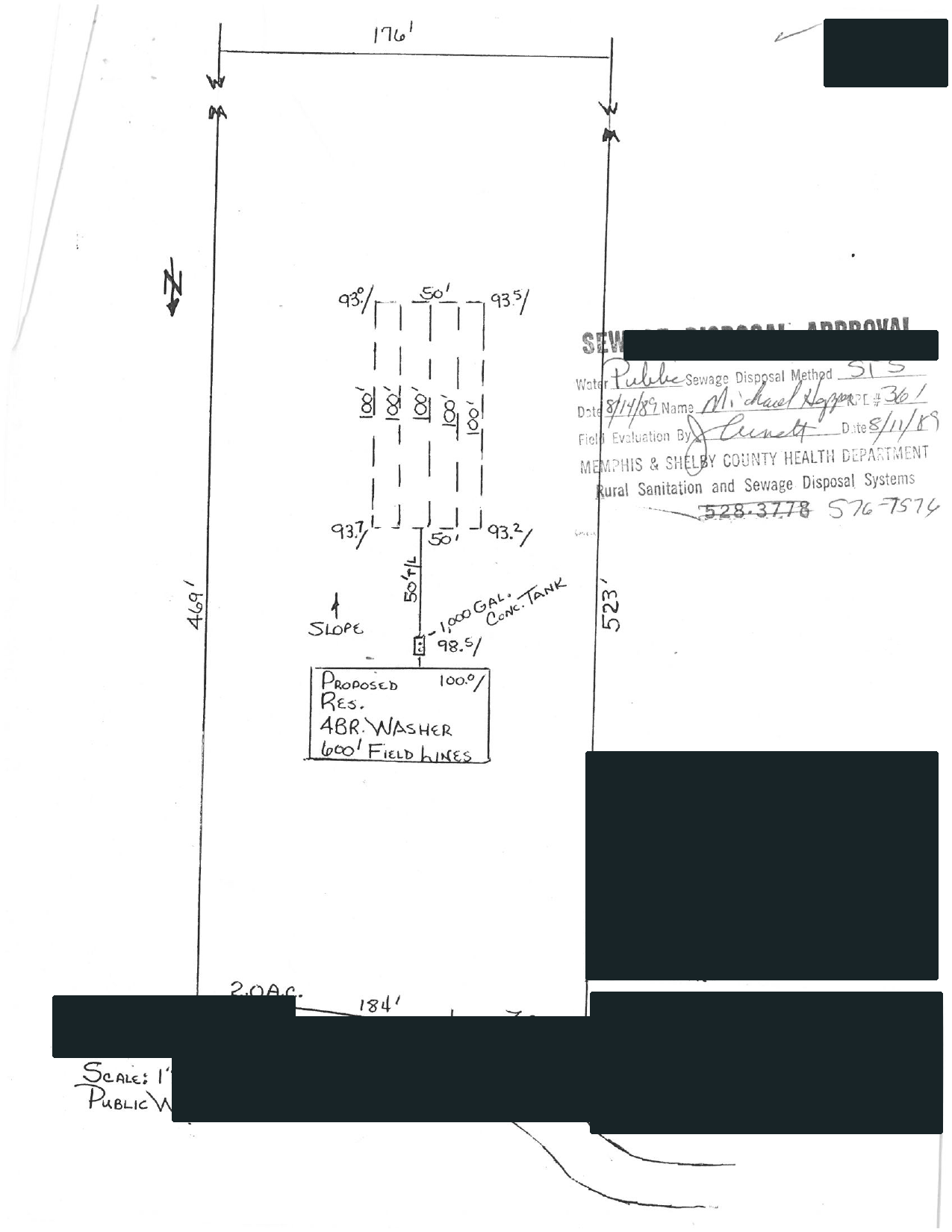
02 / EXPLAINED BY SEPTICPATH
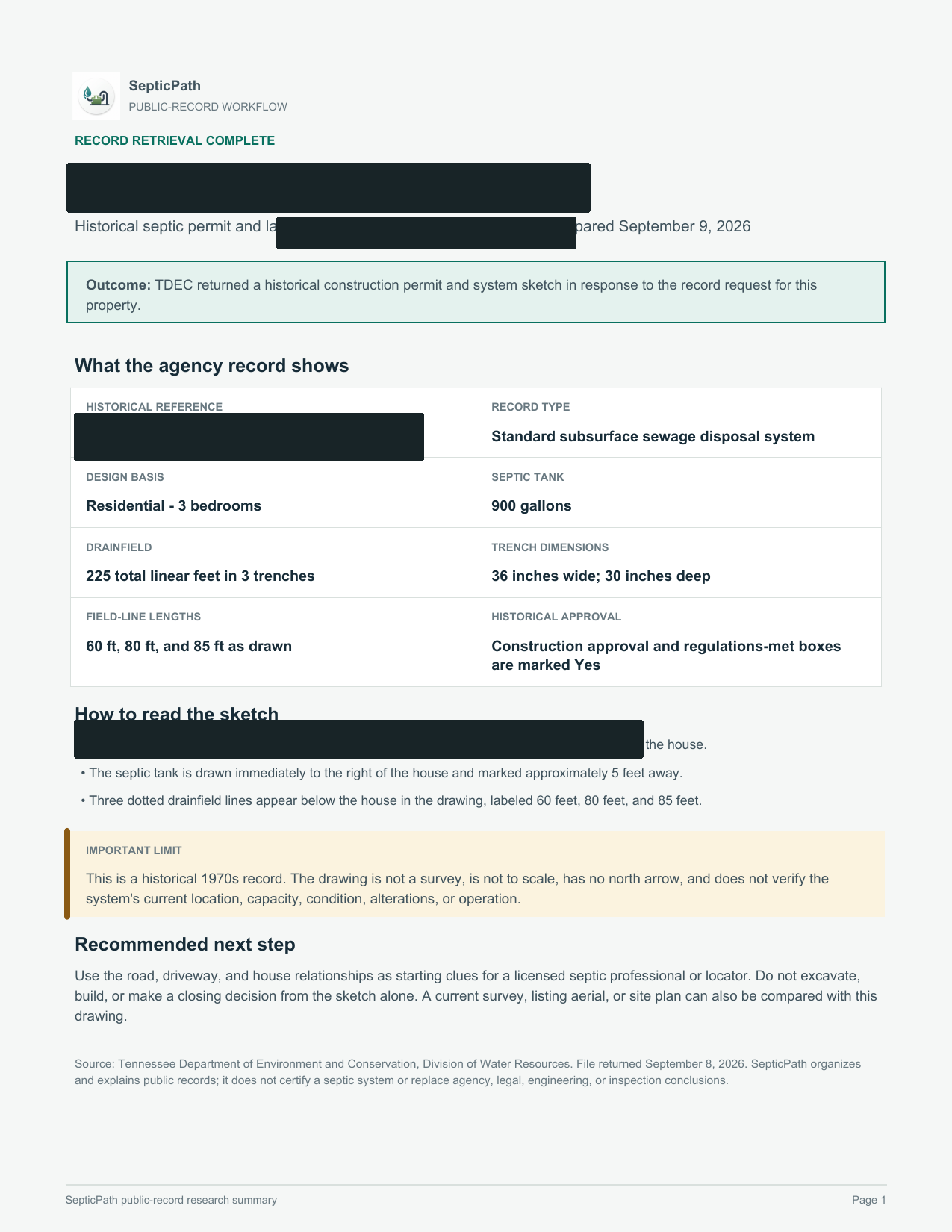
SepticPathRECORD BRIEF
What this helps withA starting point for discussing the layout with a septic professional.
What it does not proveThis is an approved design, not proof of the system’s current location or condition.
Open the delivered brief ↗Privacy reviewed: black bars remove identifying details; agency language, form structure, system data, and drawing geometry remain visible. Samples are from separate requests, not one property file. Record availability varies by property and jurisdiction.
- Search public sources
- Request agency files when needed
- Explain what comes back
Investigate my property
Send the address and what you need to find out.
Records proof ladder
Turn the lookup into the exact file task before pricing.
For Minnesota, use these routes when the search needs a parcel lookup, written records request, as-built file, or county page instead of another broad state summary.
Septic permit search by address
Use this Minnesota route when the user has an address, parcel, owner, APN, TMS, or legal-description clue and needs the right file owner before the record is treated as missing.
Open address search guideSeptic permit records request
Use this Minnesota route when the next move is asking for a permit copy, as-built, final approval, repair file, inspection letter, or written no-record response.
Open records request guideSeptic as-built records
Use this Minnesota route when the installed layout, site sketch, tank location, drain field, reserve area, or repair scope can change the next quote or deal decision.
Open as-built records guideSeptic records by county
Use this Minnesota route when the county is known and the next useful click is the local permit file, records request, parcel lookup, or office path.
Open county records guide
Official state file path
Use the official file route before another broad search.
This is the Minnesota records path to follow when the visitor needs a permit copy, as-built, inspection letter, repair trail, or written no-record response tied to a parcel.
Verification set
Owner, artifact, request, fallback
Minnesota Pollution Control Agency | Disclosing SSTS at property transfer. Treat this as the first verification lane, not as proof that every county file is online.
The written septic disclosure tied to the sale.
Start with Disclosing SSTS at property transfer, then use county or regional contact wording if the portal does not show the parcel file.
Minnesota Septic Records Checklist and Permit Lookup county trigger: You already have the parcel, address, or owner in hand and the next real move is pulling the county file.
If the Minnesota lookup has no match, ask for a written no-record response and the office that owns archived, regional, contract-county, or pre-digital septic files.
Carry the Minnesota address, parcel/APN/TMS, owner, legal description, subdivision, and any prior permit number into the next request.
Official records route
Minnesota records lookup guide
Use this Minnesota guide to pick the right office, pull the first file, and jump to a county route when the property location is already known.
Priority lane
State record lookup and county route handoff
How do I find minnesota septic records?
How do I find minnesota septic permit lookup?
How do I find minnesota county septic records?
How do I find septic permit search by address minnesota?
How do I find septic as-built records minnesota?
Search for the property's permit and supporting documents using its address or parcel number. If no record appears, ask the responsible office to check its archives.
Disclosing SSTS at property transfer provides official source context. The county instructions above identify the search or request route for an existing property file.
Local search instructions are available for St. Louis County records, Blue Earth County records, Dakota County records. Choose the property's county to find the relevant office and records route.
The written septic disclosure tied to the sale.
Common records searches
Use the Minnesota search phrase that matches the job.
Each Minnesota route below resolves a different records search into the same practical next step: identify the file owner, pull the permit trail, and then decide whether the record is strong enough to trust.
How do I handle Minnesota septic permit lookup?
Start with the official Minnesota records or local authority path, then confirm the permit file before trusting a quote, buyer story, or repair plan.
Open records pathHow do I handle Minnesota county septic records?
Use this in Minnesota when the county file owner, parcel clue, or local records request is the real next step.
Open county records routesFind the office or lookup holding the file
For Minnesota Septic Records Checklist and Permit Lookup, use the local office first when you want to move from a planning page into an actual permit or records workflow.
Open local authority sourceOpen the records lookup first
For Minnesota Septic Records Checklist and Permit Lookup, use the existing record trail to confirm whether this property still fits the low end before you move into quote mode.
Open records lookupState context Quick facts, fit, and workflow details Open when you need the full state context behind the answer panel.
Quick facts
| Rule style | Buyer-risk records workflow | Override risk | high |
|---|---|---|---|
| Last verified | 2026-03-10 | Official sources | 4 |
| Local verification links | 1 | Records links | 2 |
| Public sizing signal | Conservative fallback range | Primary first call | Start with the local SSTS program or local government office that handles septic permits, inspections, and transfer questions for the property. |
| County-backed first pull | Minnesota Septic Records Checklist and Permit Lookup file check: Parcel identifier, address, owner name, or permit number needed to pull the county file. | Hold pricing when | Minnesota Septic Records Checklist and Permit Lookup quote hold: Do not move into quote mode while the parcel, GIS, or records-request trail is still missing. |
Records lookup checklist
- Open the local SSTS program path first and confirm which county, city, or township controls the property file.
- Ask whether the local government requires a compliance inspection before transfer and whether any prior inspection report exists.
- Compare the seller disclosure against local program expectations before you trust the listing story or repair credits.
Who this page is for
Best for Minnesota buyers, owners, agents, and builders who know the property uses septic but still need to know whether the file is complete enough to trust the next quote or deal step.
- You know the parcel uses septic, but no one has confirmed which local SSTS program actually controls the file. You also need the right records lookup or permit search path before the file story is trustworthy.
- The owner says the system is permitted, but there is still no prior compliance-inspection report or comparable local file in hand.
- You need to know whether local compliance-inspection rules and seller-disclosure gaps makes the record trail more complicated than the owner remembers.
What changes this page in Minnesota
Best for Minnesota buyers, owners, agents, and builders who know the property uses septic but still need to know whether the file is complete enough to trust the next quote or deal step. Minnesota's records lookup page is strongest when it makes the permit search, county file owner, and missing document explicit. Minnesota records intent is strongest when the page connects local SSTS program routing, prior compliance-inspection report, and local compliance-inspection rules and seller-disclosure gaps instead of pretending the state keeps one simple homeowner database.
Minnesota Septic Records Checklist and Permit Lookup permit context: Minnesota homeowners and buyers usually need the local SSTS program and disclosure trail clarified before they trust a sale, inspection, or replacement quote. The deal is not really file-backed until the local program confirms whether a compliance inspection is locally required and whether the seller has surfaced the real disclosure and prior inspection paperwork. The first practical check is usually the office, file path, or reviewer identified in this state workflow: Start with the local SSTS program or local government office that handles septic permits, inspections, and transfer questions for the property.
Minnesota Septic Records Checklist and Permit Lookup local exception: Minnesota's main wrinkle is that there is no statewide pre-sale compliance-inspection rule, but many local ordinances and lenders still require one, so the local program owns the real buyer workflow. That is why this page pairs a planning estimate with official sources, records links, and a local checklist before you move into quote mode.
Main estimate drivers in Minnesota
- Minnesota records lookup gets useful only after the permit search, county file owner, or official office path is clear.
- A thin prior compliance-inspection report trail can hide the real approval story behind the current system.
- local compliance-inspection rules and seller-disclosure gaps can matter as much as the permit copy before the homeowner trusts the low end.
How this workflow usually unfolds in Minnesota
- Start with the local SSTS program and confirm who actually holds the onsite file for the property.
- Request the prior compliance-inspection report, permit file, approval path, and any written seller disclosure or transfer-related record tied to the parcel.
- Compare the records you received against the property story so you know whether the next step is buyer diligence, permit cleanup, or replacement planning.
- Then move into pricing only after the file is strong enough to trust the current system narrative.
State Pattern Summary How county files usually break down in Minnesota These county pages show the local branches that keep repeating in Minnesota. This summary is built from 5 live county workflows so you can decide which county file, replacement branch, or failure-side trigger matters before you treat the first cost number like the final answer.
Parcel and records lookup
For Minnesota Septic Records Checklist and Permit Lookup, County files often start with parcel, GIS, permit-search, or formal document-request lookup before anyone trusts the seller summary. Ask the Minnesota county for For Minnesota Septic Records Checklist and Permit Lookup, first ask for parcel identifier, address, owner name, or permit number needed to pull the county file. Seen across 5 live county pages. Examples: Blue Earth County, Chisago County, Dakota County.
File owner and local office split
For Minnesota Septic Records Checklist and Permit Lookup, Minnesota counties often split the real file owner between county health, a municipality, a board of health, or another local office. The first win is identifying the right desk. Ask the Minnesota county for For Minnesota Septic Records Checklist and Permit Lookup, first ask for the exact county, municipal, board-of-health, or CEHA office that actually owns the septic file. Seen across 1 live county pages. Examples: Dakota County.
Transfer and buyer diligence
For Minnesota Septic Records Checklist and Permit Lookup, Buyer and transfer risk often lives in inspection, property-status, PTI, or completion artifacts rather than a generic permit copy. Ask the Minnesota county for For Minnesota Septic Records Checklist and Permit Lookup, first ask for transfer inspection, property status report, PTI-backed record, or buyer-side completion proof. Seen across 5 live county pages. Examples: Blue Earth County, Chisago County, Dakota County.
Most common file owner pattern
Many county workflows in Minnesota are county-first once you reach the named local health or environmental office. Seen in 4 county pages.
Most common permit closeout signal
Minnesota county evidence: County files often need a stronger closeout artifact than the first permit mention. Seen in 5 county pages.
Most common buyer or transfer artifact
Minnesota county evidence: The most common buyer-side county artifact is a formal transfer, status, or real-estate evaluation record. Seen in 5 county pages.
Most common special program or exception
Minnesota county evidence: County pages in this state still need a special-program check even when no single program dominates the workflow. Seen in 4 county pages.
Most common malfunction or repair trail
Minnesota county evidence: County pages in this state often move into a repair, malfunction, or off-lot-discharge branch before the low-end scope is real. Seen in 4 county pages.
Most common quote gate
Minnesota county evidence: The most common quote gate is a repair, malfunction, or failing-system branch that has to be cleared before pricing is trustworthy. Seen in 5 county pages.
First county artifacts to pull
- Minnesota Septic Records Checklist and Permit Lookup file check: Parcel identifier, address, owner name, or permit number needed to pull the county file.
- Minnesota Septic Records Checklist and Permit Lookup file check: The exact county, municipal, board-of-health, or CEHA office that actually owns the septic file.
- Minnesota Septic Records Checklist and Permit Lookup file check: Transfer inspection, property status report, PTI-backed record, or buyer-side completion proof.
Drop to a county page when
- Minnesota Septic Records Checklist and Permit Lookup county trigger: You already have the parcel, address, or owner in hand and the next real move is pulling the county file.
- Minnesota Septic Records Checklist and Permit Lookup county trigger: The story mentions a town, local board, or other office that does not sound like the main county file owner.
- Minnesota Septic Records Checklist and Permit Lookup county trigger: The real question is closing risk, lender diligence, or inspection leverage rather than basic permit history.
Do not quote yet when
- Minnesota Septic Records Checklist and Permit Lookup quote hold: Do not move into quote mode while the parcel, GIS, or records-request trail is still missing.
- Minnesota Septic Records Checklist and Permit Lookup quote hold: Hold off on pricing if the caller still does not know which office actually owns the septic file.
- Minnesota Septic Records Checklist and Permit Lookup quote hold: Do not jump to quote mode while the buyer or lender still lacks the transfer-side inspection or status artifact.
County Wedge
County record pages behind this state workflow
Use these Minnesota routes when this Minnesota Septic Records Checklist and Permit Lookup page is still too broad and the real blocker is a specific county file, location request, or local records form.
St. Louis County Minnesota Septic Records Checklist and Permit Lookup
Open county pageBlue Earth County Minnesota Septic Records Checklist and Permit Lookup
Open county pageDakota County Minnesota Septic Records Checklist and Permit Lookup
Open county pageChisago County Minnesota Septic Records Checklist and Permit Lookup
Open county pageOlmsted County Minnesota Septic Records Checklist and Permit Lookup
Open county pageVerification layer Prep checks and official sources Open when you need the authority links, records sources, and low-end risk checks.
Start with this file prep
Who to call first. Start with the local SSTS program or local government office that handles septic permits, inspections, and transfer questions for the property.
Records to request.
- The written septic disclosure tied to the sale.
- Any prior compliance inspection report in the seller's possession.
- Any local SSTS permit, inspection, or compliance-status note already tied to the property.
What makes the file less trustworthy in Minnesota
State-level checks.
- If the local program requires a compliance inspection for transfer, the seller disclosure alone is not enough to trust the low end.
- If a prior inspection report exists but has not been surfaced, the buyer may be inheriting more risk than the listing suggests.
- If local ordinances are stricter than the statewide baseline, the deal can widen beyond a simple inspection or credit conversation.
- Minnesota looks statewide through MPCA, but the real buyer workflow changes quickly once you know which local SSTS program controls the property and whether local transfer rules are stricter than the statewide baseline.
Page-specific checks.
- The low-end file story breaks if no one has identified the local SSTS program holding the actual record.
- A missing prior compliance-inspection report can hide a very different system path than the owner summary suggests.
- local compliance-inspection rules and seller-disclosure gaps can make the file much more demanding than a generic record lookup implies.
Permit timeline watch
Minnesota timing often turns on how quickly the local SSTS program confirms transfer requirements, whether a prior inspection report exists, and whether local ordinances demand more than the statewide disclosure baseline.
When the missing file becomes a deal problem
Buyers should ask for the disclosure form, any prior inspection report, and the local SSTS transfer rule early because Minnesota's local compliance requirements can change the deal fast.
Maintenance / inspection note
Minnesota's current source set is strongest on local-program control, transfer disclosure, and compliance-inspection risk, not on one simple statewide maintenance cadence.
Special state wrinkle
Minnesota's main wrinkle is that there is no statewide pre-sale compliance-inspection rule, but many local ordinances and lenders still require one, so the local program owns the real buyer workflow.
Bring this into the next records lookup
- The local SSTS program identified for the property.
- Any prior compliance-inspection report, permit file, design packet, or approval note already tied to the parcel.
- Any written seller disclosure, transfer, complaint, or follow-up record already in the file.
- A short summary of the real use case: buyer diligence, permit cleanup, replacement planning, or service-history check.
Official file and lookup links
Minnesota: Find the office or lookup holding the file.
- Minnesota Pollution Control Agency Local septic system programs
Open the records lookup first.
- Minnesota Pollution Control Agency Disclosing SSTS at property transfer
- Minnesota Revisor of Statutes 115.55 Individual sewage treatment systems
- Minnesota Pollution Control Agency Subsurface sewage treatment systems
- Minnesota Pollution Control Agency Local septic system programs
- Minnesota Pollution Control Agency Disclosing SSTS at property transfer
- Minnesota Revisor of Statutes 115.55 Individual sewage treatment systems
FAQ
Minnesota questions this page should answer before a quote request.
Who holds Minnesota septic records in practice?
Usually the local SSTS program, which is the first office to identify before you ask for the prior compliance-inspection report or any transfer paperwork.
Does Minnesota have a septic permit lookup?
Use the Minnesota records lookup path to find the permit search, county file owner, or official office that can confirm the permit, as-built, inspection, or repair record before quotes.
Turn the records route into a property-file decision
Find the official permit or county file first. If a sale or offer is moving, use the free check to identify the bedroom-count, parcel-match, approval, repair, or missing-record question that still needs an answer.